Designing a mobile app can be an exciting process. It is understandable, however, that confusion around mobile app development timelines can be frustrating. Having insight into mobile app development timelines can help organizations and entrepreneurs plan strategies and budgets for app development. Realistic expectations around the app’s potential launch can be maintained, and insights encourage growth towards future projects.
With many mobile app development limitations like platform selection, app complexity, design requirements, and even the need for third-party integrations, it is understandable that estimating timelines to build a mobile app can be complex. There will be a significant difference in time from the development of a simple app in comparison to the development of a complex mobile app solution.
This guide explains the main steps in app development, how long it typically takes to build an app, and methods to speed up the process.
Key Takeaways
- With sustained growth and increased competition across industries, the mobile app market is showing promise and is expected to reach over $613 billion by 2026.
- The timeline of app development is infinitely variable. The scope of the app, its features, the integrations it uses, and its overall technical complexity directly affect development time.
- The app’s overall complexity affects delivery time, testing, scalability, and maintenance.
- Simple apps can take about 2 to 3 months to build, a medium-complexity app can take 4 to 6 months, and a complex, multi-platform app can take 7 to 12 months or longer.
- The strategy of a development platform is also important, as the goal is to improve performance. Native development is better for overall performance, but separate builds are required for iOS and Android.
- In contrast, a cross-platform development framework can shorten development time by 30-40% by using a shared codebase.
- If done in the right manner, the development stages for the app can be more predictable, and the risks of delays can be lower, especially in the case of going to market.
- If done correctly, an MVP approach can shorten time-to-market while allowing for the development of additional features in the future.
- With the right development effort, the likelihood of delays caused by scope creep, integrations, or reworking changes is also minimized.
- With a deliberate, confident development roadmap, launch risks can be reduced, resources can be better distributed, and overall return on investment can be maximized.
Market Statistics: Mobile App Development & Launch Trends (2026)
Knowing the size and trajectory of the global app economy allows for better planning. Here are a few facts that put your development timeline into context.
- According to Market.Biz, mobile app revenue is expected to reach $613 billion by 2026, and growth is anticipated to continue as enterprise digitization, fintech, healthcare, and on-demand services drive expansion.
- Data.ai (formerly App Annie) reports that there are over 250 billion app downloads each year. This demonstrates the growing number of consumers who prefer apps to websites.
- The GSMA states that there are over 5.5 billion mobile phone users worldwide. Many of these users access the internet on their smartphones. This increases the need for developers to release their apps.
- Stack Overflow’s developer surveys show greater use of cross-platform frameworks and tools (like Flutter and React Native), which, in turn, reduce development time by 30-40% in many cases.
Factors Affecting App Development Time
There is no one-size-fits-all answer to how long it takes to make an app, several factors play a key role in determining the time required for app development.
1. App Complexity
- Simple apps with a small set of mobile app features take less time to develop.
- Mobile apps with complex features take longer to develop, test, and fine-tune.
2. Platform Choice
- Mobile app development timeline, deciding to make for iOS, Android, or both.
- Cross-platform frameworks like Flutter or React Native can expedite development by enabling a single codebase to run across multiple platforms.
3. Design Requirements
- It takes longer to get a signature for custom UI/UX designs than for regular templates.
- Further design, prototyping, and iterations are often needed to develop a frictionless user experience.
4. Development Team Expertise
- Senior developers and dedicated teams can be more efficient, with fewer errors and shorter lag times.
- Teams with experience in comparable projects can anticipate problems and streamline the process.
5. Third-Party Integrations
- Integrating APIs, payment gateways, or external services adds technical and operational complexity to the project.
- Even with careful planning and skilled integration teams, such dependencies can impact development schedules and require additional coordination.
By understanding these factors, you can make a better estimate of how long it will take to build an app and organize your project optimally.
Types of Mobile Apps
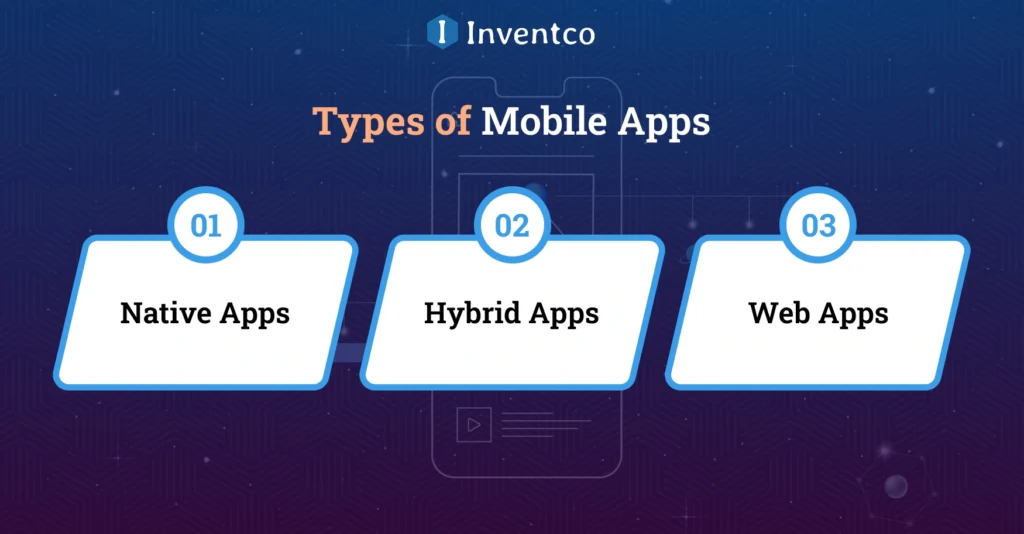
Before you start building your business mobile app, it’s essential to determine which type of app you want to create, as this decision will influence the time required for mobile app development.
1. Native Apps
This type of Mobile app is specifically made for iOS (by Apple) or Android (by Google), which allows fast performance, smooth user experience and access to full device features, but building native apps for each platform can be expensive and time-consuming.
2. Hybrid Apps
Use a shared codebase that runs across multiple platforms. The development process is quicker and simplifies mobile app maintenance, as a shared codebase makes updates and bug fixes more efficient. However, performance may not be comparable to fully native applications, and access to advanced device-specific features, including complex gestures or hardware-level integrations, may be restricted.
3. Web Apps
Web apps are accessible from a browser and require minimal installation. Progressive Web apps are faster to build and update, but lack some of the functionality or device integration of native and hybrid applications.
The type of app you pick has a direct bearing on the timeline for developing your mobile application and the costs to build a mobile app.
Stages of App Development
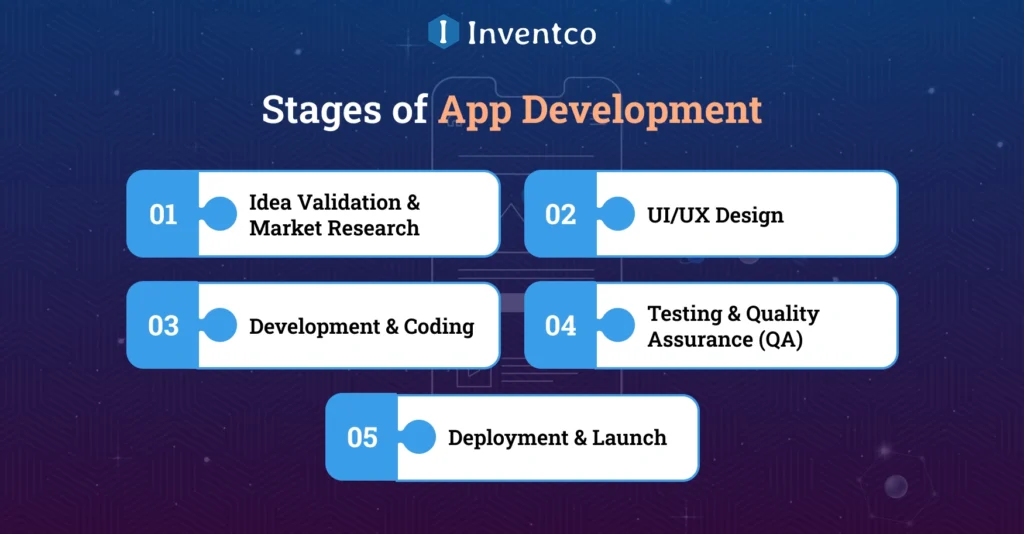
Creating a mobile app involves several stages, and each is equally important in terms of time. Understanding the basic idea behind these stages helps businesses plan more effectively and anticipate how long it will take to develop an app.
1. Idea Validation & Market Research
Before writing any code, it is important that your mobile app idea is validated and the market is researched, which involves:
- Compiling and utilizing competitor analysis to decide what works and what doesn’t.
- Identifying your target audience and their pain point so that you can solve real issues with your app.
- Identifying core features to focus on while programming.
With proper research and idea validation, one can reduce time spent on unnecessary features and lay a solid foundation for app success.
2. UI/UX Design
An amazing UI/UX is vital to keep the users coming back. During this phase, designers focus on:
- Use wireframes and a prototype to sketch out the structure of your app.
- Interactive mockups to validate features before code.
- Design flows take the user by the hand.
A well-planned design reduces the number of iterations down the line, speeding up the time to a final product.
3. Development & Coding
It is the stage where your mobile app becomes real, which includes:
- Backend Development: Servers, databases and APIs.
- Frontend: Defining the app’s appearance and functionality.
- Native vs Hybrid App Development: Native apps are platform-specific, meaning you will need to build separate versions of the code for iOS and Android.
The coding part is naturally the longest, especially for feature-rich, complex apps.
4. Testing & Quality Assurance (QA)
Quality Assurance ensures the app works, doesn’t break, and isn’t hacked. Testing typically covers:
- Unit testing to test that all functionality works as intended.
- Benchmarking for speed and responsiveness
- Mobile app security testing to safeguard user data.
- User acceptance testing to ensure it meets user requirements.
Good QA reduces post-launch issues that drain time and resources.
5. Deployment & Launch
This is the final stage where your mobile app is ready for release. However, before submission, ensure your app’s stored optimization is properly implemented; otherwise, approval delays and reduced visibility may delay your launch.
- Submit your app on Google Play Store, Apple App Store and other marketplaces.
- Verification and approval by platform regulators.
- Promote your app through app store marketing and other user acquisition strategies.
App deployment also affects your mobile app development timeline, depending on the app store review process.
Estimated Timelines by App Complexity
The time required to develop an application depends entirely on the app’s complexity. Different mobile app types require different resources, expertise, and time to build an MVP. Knowing the timeline helps businesses and developers to set realistic expectations for when they can start planning around new tools and product enhancements, without worrying about unnecessary stalls in their planning.
Simple Apps
They are easy-to-use apps with basic features and a few integrations. They tend to focus on basic details without much diversity. Small apps usually take between 2 and 3 months for development, making them an ideal choice for MVPs or testing new ideas.
Example: Calculator apps, to-do lists, or basic utility apps.
Medium Complexity Apps
Medium-complexity apps are slightly more advanced in terms of UI, with moderate integrations and a database backend. Moreover, these kinds of apps need additional mobile app testing, backend setup, and require UI/UX improvements. These apps typically take 4-6 months to develop.
Example: an e-commerce application, a booking system, or a fitness app with user and data management.
Complex Apps
Complex apps are packed with features and functionality, often spanning multiple platforms, third-party API integrations, and advanced technologies such as AI or ML. This kind of app, with the latest mobile app development trends, can take longer to develop due to the extensive coding, testing, and quality assurance required. The average time to create a complex app is 6-12 months or more.
Example: if you are looking to develop a Social media app, a fintech app, or an on-demand marketplace, such as ride-hailing or delivery applications.
| App Complexity | Features & Scope | Estimated Timeline | Examples |
| Simple | Basic functionality, minimal integrations | 2–3 months | Calculator apps, simple task managers |
| Medium | Advanced UI, database backend, moderate integrations | 4–6 months | E-commerce apps, booking apps |
| Complex | Multi-platform, API integrations, AI/ML features | 7–12+ months | Social networks, fintech apps, and on-demand marketplaces |
With these insights, organizations can plan their strategies for the seamless execution of their mobile app development process.
Tips to Speed Up App Development
When it comes to mobile app development, there are various ways to increase development speed without compromising quality. First, with a bit of resourcefulness, planning, and the right tools, there are numerous ways to streamline the development of your mobile app, to get it to market as fast as possible and without sacrificing quality
Here are some practical ways to speed up the development process:
- Use Cross-Platform Frameworks: Development tools such as Flutter or React Native are designed to help developers save time and development costs, and reduce maintenance efforts repeat efforts since they only need to build the app and create a single code base to support the app, making the app available for iOS and Android devices.
- Prioritize MVP Features: It is helpful to get an MVP up and running as quickly as possible, as it lets you push the app’s core features to market, accelerating your mobile app development.
- Hire Experienced Developers: Expert mobile app developers will decrease the resources needed for development and will be able to use their skills to reduce the development time needed to fix the iterations generated by the QA process.
- Automated Testing: Minimizing the time required to perform manual QA on the mobile application increases agility in the development process and improves the capture rate of detected defects.
- Plan Sprints & Milestones: Structured development processes greatly enhance the ability to create certain iterations of the mobile application and to perform the necessary QA cycles. To avoid planning your app launch as a rigid, iterative process, particularly on the right.
We are certain that by implementing the aforementioned strategies in your development process, all timelines can be met without sacrificing quality goals.
Common Delays in App Development
Even the best-laid plans can experience unforeseen delays. Here are a few examples of the app development challenges teams commonly run into during the app development process:
- Scope Creep: Includes adding new features during development or needing to adjust the overall plan
- Poor Communication: If gaps in communication between development teams and stakeholders can lead to unexpected delays
- Technical Challenges: If there are issues integrating third-party tools, issues with the app’s backend, or any bugs, development will slow
- App Store Review Delays: If your app gets rejected or the review process takes longer than you’d like, there are steps you can take, like adhering to the guidelines, to improve your chances of receiving a quick approval
This is why it is crucial to properly plan to give your team the ability to pivot where necessary, ensuring the app is designed and developed with realistic timelines to deliver results aligned with your business’s requirements, with the overall goal of launching the app sooner.
How Inventco Accelerates App Development with Proven Expertise?
Turning an idea into a market-ready application demands more than basic coding. It involves technical knowledge, a process in place to turn the idea into reality, a structure to adhere to, and the discipline to execute. Inventco offers full-service mobile app development, supported by seasoned engineers, UI/UX experts, and project managers with certifications in development, product architecture, scalability, and compliance across various business sectors.
We base our development approach on the Agile methodology and incorporate defined sprint cycles and milestone tracking to establish a sense of order and control. This structure allows for collaboration with the overall risk and development goals. Each process, from discovery through technical feasibility, launch, and post-launch service optimization, meets established quality and performance standards.
Inventco empower modern frameworks and cloud infrastructure, in combination with a backend system that ensures the app will work in the real world and perform to your expectations. Development goals, timelines, and launch dates will all meet expectations. Thanks to the combined efforts of skilled and technical staff, your partnership with Inventco ensures your application is developed and implemented in a timely, efficient, and safe manner.

Conclusion
There is no definitive answer to the question “How long does it take to develop an app?” Several factors, such as design, platform, and complexity, influence timelines. However, the app development timeline can be used to plan ahead. Working with dedicated teams such as Inventco can lead to a more refined development process when launching an app, saving time, easing efforts, and streamlining construction. Just remember: with the right plan, time can be saved during development, and users can benefit from the app from day one.
FAQ’s
Q1. How long does it take to develop an app?
Ans. The timeline depends on app complexity, features, platform, and development approach. Simple apps can take 2–3 months, medium apps 4–6 months, and complex apps 7–12 months or more.
Q2. How long does it take to make an app for both iOS and Android?
Ans. Developing for multiple platforms usually takes longer unless you use cross-platform frameworks like Flutter or React Native, which can significantly reduce development time.
Q3. What factors affect the mobile app development timeline?
Ans. Key factors include app complexity, design requirements, platform choice, third-party integrations, and the development team’s expertise.
Q4. How long does it take to build a simple mobile app?
Ans. A simple app with basic features and minimal integrations typically takes around 2–3 months from concept to launch.
Q5. How long does it take to develop a complex app?
Ans. Complex apps with advanced features, backend systems, third-party APIs, or AI/ML integration can take 7–12 months or more, depending on scope and team efficiency.
Q6. How can I speed up the app development process?
Ans. Prioritizing MVP features, using cross-platform frameworks, automating testing, and working with an experienced development team like Inventco can significantly reduce your development time.
Q7. How long does app testing and QA take?
Ans. Testing typically takes a few weeks, depending on app complexity. Proper QA ensures the app is stable, secure, and user-friendly before launch.
Q8. Can partnering with a company like Inventco reduce development time?
Ans. Absolutely! Inventco provides expert developers, designers, and project managers who streamline the process, reduce delays, and ensure your app launches on schedule.

Jitendra Jain
He is the CEO and Co-founder of Inventco, driving innovation in advanced computing and digital transformation. With deep expertise in modern IT ecosystems, he leads scalable, secure, future-ready solutions. His strategic leadership helps businesses accelerate growth, adopt innovation, and achieve success. You can connect with him on LinkedIn to follow his technology insights.