Today Intel is releasing their new Xeon 600 Workstation line of processors based on Granite Rapids. SemiAccurate likes big silicon and this lineup fits that bill nicely.
This new lineup of 11 Xeons has nothing unexpected, just a solid replacement for the old Sapphire Rapids based W-3500 lineup. Xeon 600 has more of everything, does everything a bit better, more efficiently, and has more features. In short it is an evolutionary upgrade that lines up solidly against AMD’s Threadripper 9000. What is launching today?
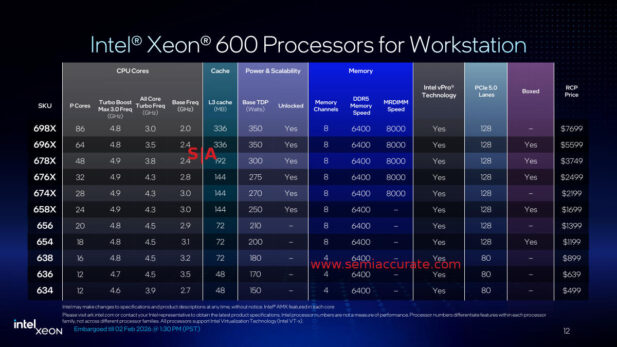
Intel Xeon 600 Workstation lineup
There really aren’t any surprises in this line, just a few technical choices visible at the high level. The first thing you will notice is that the top six SKUs have an X suffix, X is for overclockable. If you look at the workstation market, there is a lot more vendor based OCing than many realize, especially for vendors that cater to specific markets.
If you need high single threaded performance or are extremely sensitive to latency variation, there are workstation vendors that will cater to your needs. This is a fully warrantied system mind you, not a homebrew hack, and Intel is supporting that officially. The 600 adds new undervolt and overvolt protections and reporting, plus some new per-core tools and reporting. Nothing game-changing, just real world useful additions.
Similarly the 28C 674X and above support MRDIMMs at 8000MT/s which at first seems a bit odd, why not every SKU since they all have the same memory controllers? The simple answer is that Intel says the lower SKUs don’t benefit from the added bandwidth, you will only see benefits at the 28C and above levels. We believe this, and it probably saves a little cash on testing and validation.
The last odd bit is the choices of boxed SKUs. There are five Xeon 600s that you will see in retail, the other six are vendor only/tray. Most of this is irrelevant but the top 86C model seems like an odd omission. Intel says, and SemiAccurate believes, that almost no one buys these models retail, and the sales of the 86C 600 would be tiny. Hard to argue that a $7699 CPU doesn’t fly off the shelves at the local Micro Center as an impulse buy. All this said, like every other tray CPU out there, it will be for sale individually if you do a search, it just won’t come in a pretty box with a manual written in 1.3 point font.
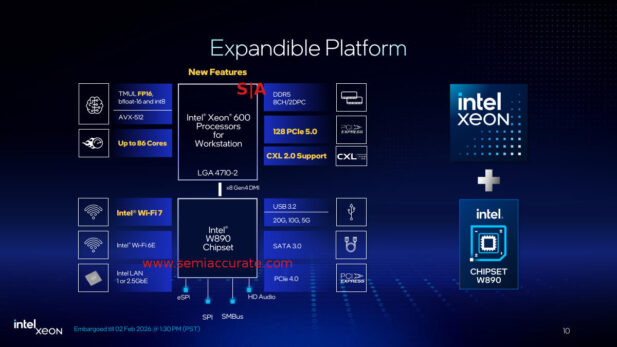
Intel Xeon 600 Workstation block diagram
So what do you get with the Xeon 600 line? Since it shares a platform with the prior Sapphire Rapids based line, it looks very familiar. 128 PCIe5 lanes is the highlight but don’t underestimate CXL2.0, that is a big and potentially useful feature for some customers. The W890 chipset adds Wi-Fi 7 which is useful but the number of workstations using a wireless connection is probably rather small. Everything else is more of the same, slightly more feature rich than the Threadripper 9000 line but no one is going to base workstation purchases on USB port count or SATA support.
The biggest feature that differentiates Xeon 600 is the support for two DIMMs per channel, something Threadripper can’t do. It may sound silly but the workloads that workstations, real workstations, are tasked with can be seriously memory bound. AMD supports 2TB per socket, Intel supports 4TB, a huge deal for many customers… if you can afford it, but that isn’t Intel’s fault.
That brings us to the obvious next topic, price. Xeon 600 ranges from $499 to $7699, about where you would expect them to land. Compared to AMD’s Threadripper Amateur/Pro line, prices are a bit better. The 86C Xeon 600 is a little cheaper than the 64C TRP 9985WX, has more cache, but only peaks at 4.8GHz vs AMD’s 5.4GHz. In practice any turbo numbers across tens of cores are a tad hypothetical and since we don’t have either system on hand we can’t speak to real world sustained/achievable performance. Intel looks to be a little slower and a lot less expensive at any comparable point but AMD scales a little higher, 96C vs 86C. If you can max out 86C on a workstation for a human-relevant time frame, tip of the hat to you.
Unfortunately for both Intel and AMD, as of this writing there is a big issue for the workstation market, DRAM pricing. Yes we had to go there, it is the clickbait site topic of the moment, or at least one of them. A quick look at Newegg shows the cheapest 32GB DDR5/6400 stick with ECC is currently $699, $1899 for 64GB. Note that is per stick and you need at least eight for the system. In light of this, does the CPU pricing matter? If you want to get to the 1TB level, you need 128GB DIMMs, $2699 as of this writing, so $21,592 in DRAM to get to 1/2 the AMD cap and 1/4 the Intel cap. Is CPU pricing relevant at this point? Does one quibble over an employee asking for an upgrade to get the $1699 20C Xeon 656 instead of the $1399 18C 654? That difference is a little less than half of the smallest DIMM you can get for either system so…
Now for some technical minutia and trivia. As you may know the Sapphire Rapids and Granite Rapids architecture is a mix of 1-3 core dies with two IO dies flanking them. The top two Xeon 600 SKUs are 3-die XCC parts, the next four, 658X-678X are 2-die HCC, and the rest are 1-die LCC. You can see this in the cache breakdown fairly clearly.
The socket for the Xeon 600 and the server Granite Rapids SKUs is physically the same but the workstation parts need the chipset to boot so if you put one in a server board, it won’t post but nothing will be harmed. The server parts won’t boot in the workstation boards for the same reason, they don’t recognize the chipset.
Similar to the MRDIMM story, there are several accelerators from the server line that are disabled on the consumer boards. IAA, QAT, and DLB are off but DSA is on. Intel says this is for two reasons, first is that the disabled units aren’t really workstation relevant, and while we could argue over QAT, the other two are clearly correct. They also draw power when not hard disabled and thus limit OCing and performance even if they are never used. Overall we think this is the right decision even if it feels a little wrong before you stop and think about it.
In the end Intel is claiming the new Xeon 600 is 9% higher in single threaded performance, 61% faster in multi-threaded workloads, and more feature rich. Best of all Intel is shedding the noxious product micro-segmentation idiocy of the past and that has worked it’s way down to the workstation level. Go team! All SKUs should be available in late March along with a flurry of workstations from the usual suspects bearing them, it should be a solid launch.S|A