“A message from the dev team:”
Maybe in years past, such an intro would fill us with excitement and anticipation; after all, a peek behind the development curtain is always a welcome treat. But in 2026, the line is a signifier of bad news.
Said opening almost always leads to the following:
“We’ve got some news today. As the launch date has approached, it’s become clear that [GAME] needs a little more time to bring it to the quality that we want for it and that you deserve. Therefore, we’ve taken the difficult decision to delay the game until next year.
We know this is disappointing, and it’s not a decision we make lightly. However, we’re looking forward to sharing the game with you without compromise, with our original vision intact.”
Whether you have a casual interest in the industry or you are the most capital of Capital-G-Gamers, we’d wager that you’ve seen something like this at least once in the past 12 months. You probably saw a couple in the 12 months before that, too. And the year before that. And th…
Demand for games remains high, but delays seem to be cropping up more in recent years than ever before — heck, remember when Devolver Digital made a whole ‘Delayed’ showcase back in 2023? No one sub-group of developers or publishers is guiltier than any other, either. Indies and AAA releases alike are pushed from the planned launch to a later date, window or, occasionally, indefinitely. It feels like it’s happening all the time.
‘Please Understand’ – The Delay Cycle
To illustrate our point, here are a handful of games we were really looking forward to that got delayed on Switch in the last 12 months alone:
- 007 First Light –
27th Mar 202627th May 2026 - Borderlands 4 –
3rd Oct 2025TBA - Date Everything! –
24th Oct 2024,14th Feb 2025, 17th Jun 2025 - Demonschool –
2023,13th Sep 2024,3rd Sep 2025, 19th Nov 2025 - Elden Ring: Tarnished Edition –
2025, 2026 - Inazuma Eleven: Victory Road –
2019,Spring 2020,2023,2024,21st Aug 2025, 13th Nov 2025 - Mina the Hollower –
31st Oct 2025, TBA - Old Skies –
23rd Apr 2025, 27th May 2025 - Professor Layton and The New World of Steam –
2025, 2026 - System Shock 2 –
26th Jun 2025, 10th Jul 2025 - Tales of the Shire: A The Lord of the Rings Game –
Q3/4 2024,25th Mar 2025, 29th Jul 2025 - Terminator 2D: NO FATE –
5th Sep 2025,31st Oct 2025,26th Nov 2025, 12th Dec 2025 - Witchbrook –
Winter 2025, 2026
That was just 2025 delays, and without mention of the giant GTA 6-shaped hole in the middle of it all. So, when we say it feels like it’s happening everywhere, we really mean it.
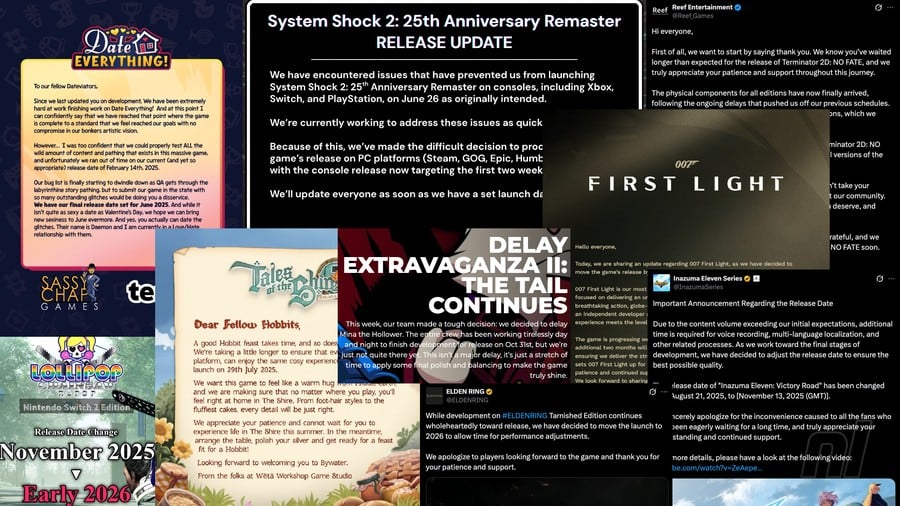
Don’t get us wrong, we’d much rather that a game is delayed and launches in a good state, than being rushed out with missing features or more serious issues to boot. Our backlogs are long enough already, so hearing that something has been pushed back from a busy season isn’t always the worst news. It’s just confusing when it happens time and again.
Why does it keep happening? The industry is hurting, the COVID-19 pandemic threw everything off, and economic factors obviously hold huge influence over decisions, but there has to be more to it. With so many games being delayed, it surely can’t just be a case of unexpected bumps in the road to release, where project managers aren’t learning from previous well-publicised mistakes.
“Most often, it stems from teams missing their production goals or not quite reaching the level of quality they want from their project,” System Shock 2 producer Justin Khan tells us. “This delay actually stemmed from our initial desire to upgrade the project from Unreal Engine 4 to Unreal Engine 5 for these ports. We spent several months on this exploration, during which we were unable to successfully deploy to the Switch and Switch 2 […] With more time, I’m sure we could have made the engine upgrade work and deployed on all platforms, but production time was running short, and so we had to pivot quickly.”
Experimentation was a similar time sink in Revolution Software’s Broken Sword – Shadow of the Templars: Reforged, which landed a last-minute Switch delay back in 2024. “We initially used tools to help upscale and then over-draw,” studio co-founder Charles Cecil tells us, “[but] we pretty quickly realised that artists recolouring the backgrounds from scratch resulted in a much higher quality than when attempting to use these tools.”
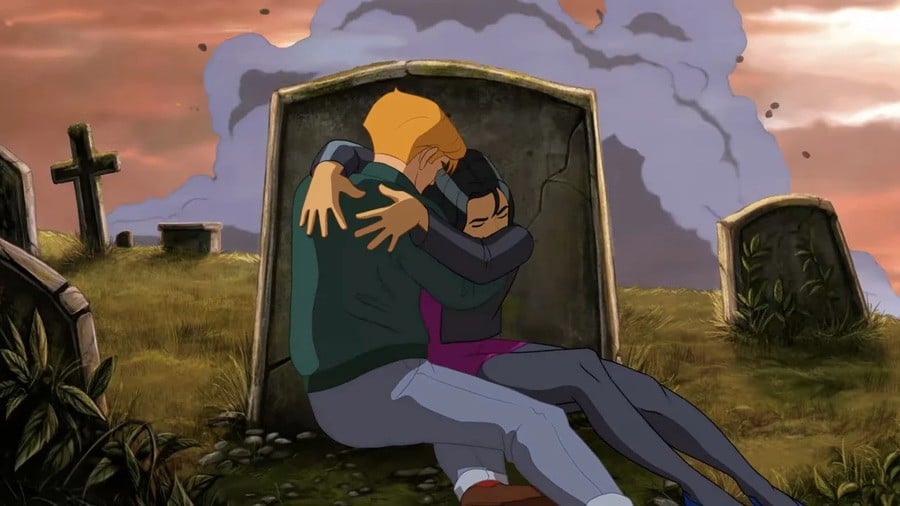
“Sometimes there isn’t a great explanation or nuanced message that could be written that wouldn’t be [better summarised] by a simple ‘we need more time’,” says Khan.
Sassy Chap Games echoed this sentiment when we spoke about Date Everything’s second delay last year (“It was absolutely a blessing that we had the delay to make sure that everything was ironed out and gone through”), as does Celia Schilling of Yacht Club Games’ Mina the Hollower. “The team needed more time to apply some final polish and balancing to the game,” she says. “We know that indefinite delay announcements can feel scary, especially in the indie scene, so we wanted to explicitly express that this delay wasn’t a major one.”
The reason itself vary between projects, naturally, but what remains consistent across many of the dreaded delay messages is a genuine attempt to apologise and convince fans that it’ll all be worthwhile in the end. Given the passion of fans and the familiarity of the delay announcement format, it’s a difficult message to get right.
“We didn’t want to do the big text screen jpeg that everyone shows on social media,” Necrosoft’s Brandon Sheffield says about Demonschool’s last-minute delay message. “So we kept the statement short, and just tried to move along. We ignored all the people being mad at us as best we could.”
It’s easy to suggest that devs should just announce their games closer to release, but very few indie studios have the luxury of near-silence until launch that we see from a Team Cherry or ConcernedApe. For players, though, it’s a disheartening experience when months of buzz and trailers leave you excited to play a game at a specific time (over a holiday or long weekend, let’s say), only for that prospect to be taken away at the last second.
Rest assured, the developers are similarly disappointed. “In our case, it was a tough decision, but we unanimously agreed it needed to happen”, says Schilling. Nightdive’s Khan agrees:
“Demoralisation is a strong word, but it accurately describes the situation when the team works incredibly hard, pulling long hours to meet an approaching deadline, only for the game to be delayed anyway. In those moments, it can feel like all that effort was for nothing. But the relief sets in quickly knowing that there is now additional time to polish things further and ensure the final product is as high quality as possible.”
Even if a delay needs to happen, that’s not to say that the dev necessarily wants it to. Aside from player expectations, which Sheffield describes as a “big worry” in the run-up to a delay announcement, there’s also the team itself to think about. Though it can bring relief, a delay can also extend stress even longer.
“Overall I think the delay was good for us, but it did cause a lot of turmoil within the studio, and contributed to burnout, among other things,” Sheffield says of Demonschool’s second delay. “It was better for the game, and better for us in the long run, but it definitely wasn’t fun, we didn’t take it lightly, and we hope to not do anything like that again anytime soon!”
Planning Problems vs. Outside Influence
Nobody wants a delay to happen, so do we have to question the practice of choosing an initial release date instead? If devs know that bumps, experimentation, and polish time are likely, why pick a release date that underestimates them? At this point, surely there’s enough project timeline data on the causes of delays to suggest that no, you’re probably not going to hit that November launch.
For Nightdive, System Shock 2’s release date “was forecasted by doing some optimistic time horizon math,” with specific weekly targets that the team needed to hit to remain on track. For Yacht Club, it was based on how the game had performed at SteamNext Fest and SGF. Plus, “Halloween felt fitting, and it lined up perfectly with our plans.”
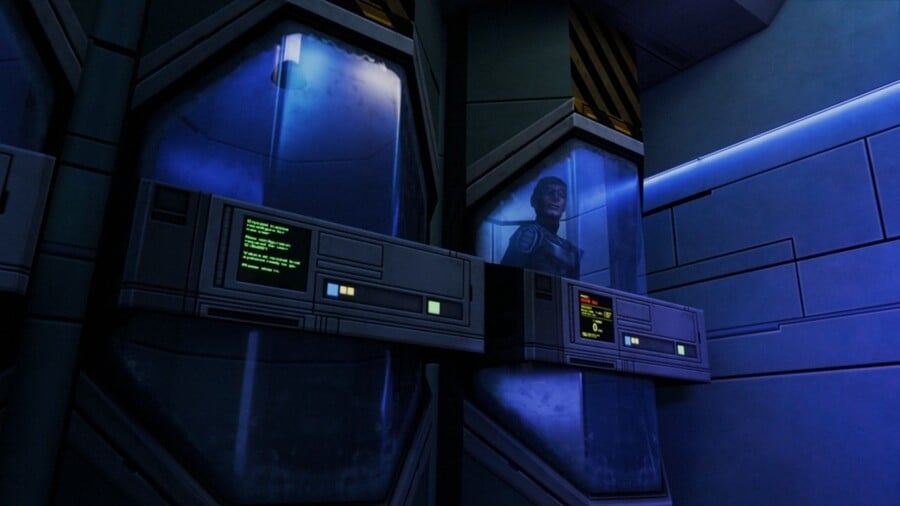
There’s certainly an element of better scheduling practices needed. A delay by a couple of days/weeks/months is understandable, but what were you thinking with the original date otherwise?
Other bumps in the road can affect plans, too. Nintendo’s eShop certification process is a long one (if you can believe it, with some of the titles that end up on there), and we’ve heard of several developers getting caught in the bottleneck and missing their launch because they didn’t have the final copy ready for Nintendo’s approval in time — “a minimum of 30 days before your release date,” according to Khan. It’s a similar story told by Wadjet Eye Games’ Dave Gilbert last year, when Nintendo’s “frustrating” cert process meant the point-and-click adventure game Old Skies was delayed at the eleventh hour despite being submitted months before.
Such problems are multiplied on the physical front. Bitmap Bureau pushed Terminator 2D: NO FATE from its initial launch date three times due to “ongoing global trade and tariff changes that delayed shipment of the components for our Day One and Collector’s Editions”. It’s difficult to block out release windows when cart production and supply chain problems are out of your control.
Then, of course, there’s the big issue that very few studios want to discuss outright: budget. Aside from being demoralising, a delay is an expensive affair, often requiring months’ worth of extra funds from somewhere to get across the finish line.
“Previously, the ‘waterfall’ approach favoured by publishers locked scope, time, and cost into a rigid contract,” Cecil says. “If any aspect of the work required was underestimated, then the only variable that could be cut back would be quality.”
The nature of post-launch updates, promised fixes, and DLC down the line means things are slightly different these days, but a game’s initial budget still usually dictates when work on a project must end. After all, how can you keep tweaking when all the funds have dried up?
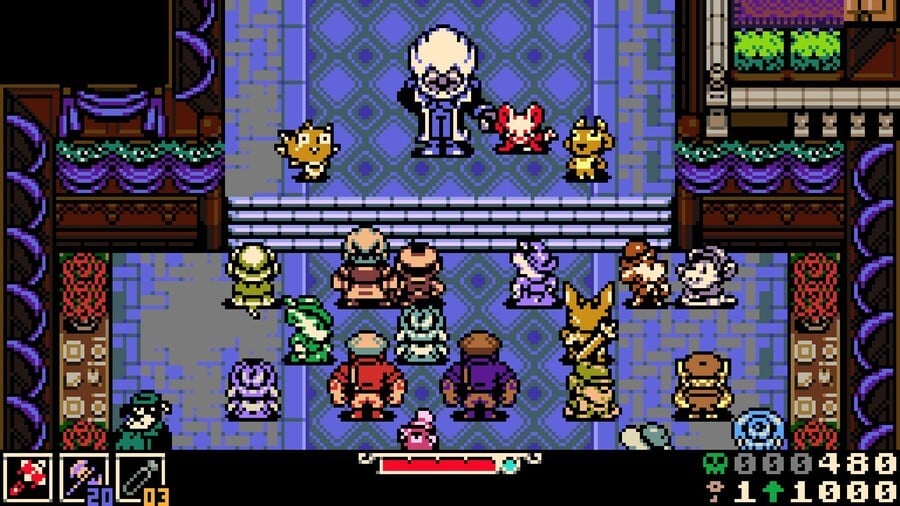
While Schilling says she’s confident Yacht Club’s “financial runway is still there” for Mina, she admits that the team “had to make our operations costs stretch and cut back on expenses like our office space.” A Bloomberg report last year confirmed that the studio planned to be fully remote by 2026. Likewise, Broken Sword’s delay “pushed our finances to the limit,” says Cecil, with the project relying on Kickstarter support to “achieve our desired level of ambition.”
On the flip side, there are occasions where a delay sees the publisher pick up the slack, as was the case for Demonschool: “Basically if our publisher hadn’t kindly decided to fund us during that delay it would’ve been impossible. So thanks to Ysbryd for that!”
Live service models aside, it seems clear that launch for many titles is increasingly a necessity to get some money rolling in so that post-launch development can continue – a form of Early Access without the label, essentially. If everything has been squeezed dry and the project still isn’t up to snuff, what option do you have?
Of course, big players like Nintendo can silently sit on games for months before launch, but that’s a huge anomaly in the industry at large. (Yes, before you say it, Metroid Prime 4 is certainly an outlier.) In retrospect, Tears of the Kingdom’s delay felt as much a question of picking the perfect launch window for the marketing campaign as it did the game needing extra time in the oven.
And what about, after all that planning, something else comes along to disrupt the waters? Following Silksong’s surprise launch a mere two weeks after its long-anticipated release date announcement, the likes of Demonschool and Baby Steps were pushed back to escape the blast radius.
“We had a special case in that 100% of the reason we delayed Demonschool was because Silksong announced it was releasing the day after us,” Sheffield tells us. “We knew we couldn’t compete with them for attention, so we were forced to delay.”
‘Thank You For Your Patience’ – What’s The Answer?
It’s a multi-pronged problem, then. It would be easy to sit here and say that a delay could have been avoided with better planning at the jump, but certification woes, economic troubles, and budgetary constraints aren’t as easily predicted as ‘we might need more time to test XYZ’.
Not making an announcement until everything is set in stone feels like an obvious fix, but you need a lot of established street cred — and money in the bank — to pull off a shadow drop, and the marketing train has got to leave the station early if you’re a small to mid-sized dev and you want your roguelike deckbuilder to stand out in the crowd.

The 2026 release calendar is yet another year bolstered by its predecessor’s delays. Scan through the list that we outlined at the start of this article, and you’ll see a bunch of tentative ‘2026’ dates still hanging on games that were slated for the year prior. No biggies have been pushed back in the early weeks of this year, but it’s only a matter of time. Delays will come, and when they do, we won’t be surprised.
So what’s the solution? Every developer we spoke to seemed genuinely confident in their initial dates, and it was only once launch loomed that it became apparent all the pieces wouldn’t fit together. ‘More realistic scheduling’ feels a little oversimplified.
With more layoffs and studio closures happening every month, the ‘quick fix’ of improved budgets and resources also seems unlikely. If studios could find a way to better handle the unexpected and land on their launch date with their project — and their well-being — still intact, brilliant! But without a radical shift in how profits are distributed amongst large companies, it’s unclear where that money could come from.
“It’s all business at the end of the day, which is hardly ever just black or white,” Khan says. There’s no one-size-fits-all approach to stopping delays for good, but if indies and AAA behemoths are equally likely to succumb to deadline drama, then we can’t see them going away any time soon.
Our thanks to Brandon Sheffield, Celia Schilling, Charles Cecil, and Justin Khan for taking the time to talk to us.
What do you make of the regularity of game delays? Is there a solution? Let us know your thoughts.